


Responsible AI: An Executive Guide
An AI policy is not the same as responsible AI. For executives who want to…

Let’s face it: Your employees are already using AI. And if you don’t know how, where, or why… you could be at risk. Data breaches, regulatory violations, or exposure of your intellectual property.
And now you are stuck between two losing strategies: ban AI completely (which is impossible) or let employees use it freely, which ignores hidden risk. Every time someone uploads client data, proprietary information, or confidential documents to a public AI platform, you’re creating potential problems that are hard to untangle and expensive to fix.
The right answer is governance: clear policies, enforceable guardrails, and a strategic framework that lets your firm capture AI’s efficiency gains without gambling on risk.
That’s what we build.
You don’t need more suggestions on what tools to try. You need a governance framework that makes AI safe to use in your business. As a Certified Chief AI Officer and Scaling Up Coach, Steve brings 40+ years of technology implementation experience—from the Marine Corps to building and exiting six tech companies. He’s lived through every major shift: cloud computing, blockchain, and now AI. He knows what works, what fails, and how to implement AI with proper guardrails to mitigate risk.
Know exactly which AI tools your team is using, what’s creating risk, and how to decide where AI can have the most impact.
With clear policies that everyone can understand and follow, without impeding innovation and growth.
Understand where AI creates real value without undue risk. Prioritize implementation around your biggest opportunities.
Human-in-the-Loop AI
Using AI alongside humans who maintain final approval on critical decisions. We implement guardrails that prevent AI hallucinations from becoming business liabilities.
Private AI Infrastructure
“Using AI as a strategic thought partner without exposing proprietary data to public models, ensuring your sensitive information never trains external systems.
Governed Automation
Using AI to reduce bottlenecks, and to monitor trends and opportunities for improvement. Automate the repetitive work while protecting against the risks
ROI Measurement
Using a shared dashboard to calculate actual ROI on your AI projects. Most clients see measurable efficiency and profit gains within 90 days of proper implementation.
Gives your firm the visibility, policies, and strategic direction to integrate AI into operations while avoiding risk.
Phase 1: Find the Exposure
You know exactly what’s happening with AI in your business — including what you didn’t know to look for.
Phase 2: Build the Guardrails
Unauthorized AI use stops. Compliance risk drops. Your team has clear rules — not vague guidelines.
Phase 3: Implement Strategically
You capture AI’s efficiency gains with confidence — not paralysis, and not reckless exposure.
An AI policy is not the same as responsible AI. For executives who want to…

Most leadership teams don’t have an AI problem. They have an infrastructure problem that AI…
Most executives expect an AI strategy to deliver transformation from day one. But those first…
Ask most executive teams whether employees are using AI without approval, and you’ll get some…

Most leaders I talk to are focused on the wrong problem. They want to know…
People need a shared foundation to anchor to when the change gets hard, when the…
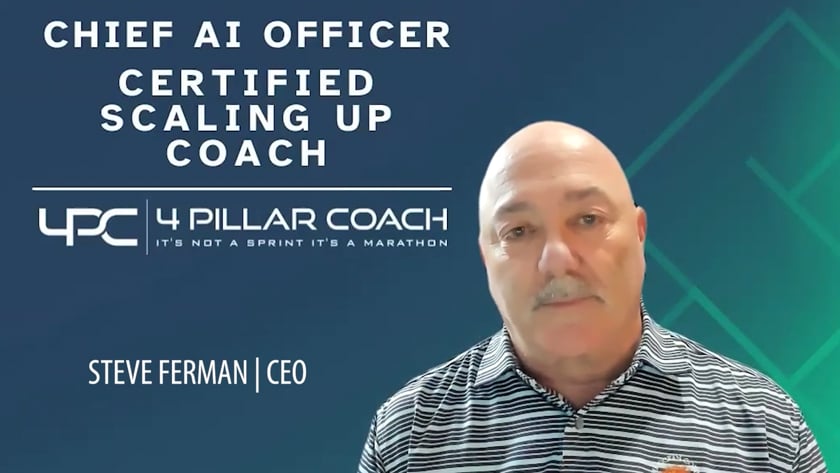
Steve Ferman is a Certified Chief AI Officer (CAIO), Certified Scaling Up Coach, entrepreneur, author, and technology executive with more than 40 years of business leadership experience.
Over the course of his career, Steve has built, operated, acquired, and successfully exited multiple technology companies while helping organizations improve operations, increase profitability, and scale sustainably.
His work today focuses on helping executive teams adopt Artificial Intelligence safely, strategically, and responsibly through governance, education, operational planning, and measurable implementation.
While our AI framework can be adapted to virtually any organization, we have extensive experience working with:
Most AI consultants begin with technology.
We begin with business strategy.
AI should never be implemented simply because it’s available. Successful organizations first define their business objectives, operational challenges, and desired outcomes before determining where AI can create measurable value.
Our philosophy is simple:
People First. Process Second. AI Third.
This creates sustainable adoption, higher employee engagement, stronger governance, lower risk, and significantly better return on investment.
A Fractional Chief AI Officer (CAIO) provides executive-level AI leadership without the cost of hiring a full-time executive.
As your CAIO, we help you:
Many organizations already have employees using AI tools without executive oversight.
Without governance, businesses may unknowingly expose themselves to:
Governance allows organizations to innovate responsibly while protecting their people, clients, and business.
The AI Readiness Assessment is our comprehensive evaluation designed to determine whether your organization is truly prepared for successful AI implementation.
Rather than focusing only on technology, we evaluate the entire business ecosystem, including:
The result is a clear understanding of where your organization stands today—and exactly what should happen next.
The AI Exposure Audit is a focused risk assessment that identifies where your organization may already be exposed to risks from ungoverned AI use.
It examines areas such as:
The AI Exposure Audit may be purchased as a standalone service for organizations that want a quick understanding of their current exposure or as part of the full AI Readiness assessment.
The AI Readiness Blueprint Roadmap is the strategic implementation plan created after completing the full AI Readiness Assessment.
It provides executive leadership with a practical roadmap that prioritizes initiatives based on business impact, organizational readiness, and risk.
Your roadmap includes:
This becomes your organization’s blueprint for responsible AI adoption.
The AI Exposure Audit is an excellent starting point for organizations that want to quickly understand their current AI-related risks.
However, the full AI Readiness Assessment is our recommended approach because it not only identifies areas of exposure but also evaluates your organization’s overall preparedness and delivers a comprehensive AI Readiness Blueprint Roadmap.
Understanding where your risks exist is important.
Knowing exactly how to address those risks—and how to implement AI successfully—is significantly more valuable and takes substantially more time to get right.
Our services include:
Our primary role is strategic leadership.
We help organizations determine:
When technical implementation is required, we work alongside your internal IT team or trusted implementation partners
No.
Because we are software agnostic, our recommendations are based solely on what is best for your organization—not on commissions or vendor incentives.
Yes.
We provide customized AI training for:
Training ranges from introductory AI literacy to advanced operational use cases.
Absolutely.
We help organizations establish practical AI governance that includes:
Most engagements follow five phases:
This structured approach ensures every AI initiative supports your business goals while minimizing unnecessary risk.
Yes.
Our ideal clients are organizations that recognize AI as a strategic business capability and want executive guidance without hiring a full-time Chief AI Officer.
Many of our clients have annual revenue between $5 million and $100 million.
While every organization is different, clients commonly experience:
Technology alone does not transform businesses.
Leadership does.
Steve combines decades of executive leadership, entrepreneurial success, business coaching, operational strategy, and AI expertise to help organizations implement AI in a way that is practical, responsible, and aligned with long-term business growth.
The objective is not simply to use AI.
The objective is to build a stronger, more efficient, and more resilient organization.